Central European – Iberian – Italian knowledge sharing for the enhanced utilisation of geothermal waste heat
Calcite scaling and silica scaling have been some of the issues with waste heat utilisation of geothermal energy in the Azores and Tuscany. Increased scaling facilitated by lower temperature reinjection (following increased waste heat utilisation) can also cause problems in the reinjection well.
A solution has been developed and implemented in the Azores, while a project is currently investigating potential solutions in Tuscany in the ongoing EU funded Horizon Europe GeoFlexHeat project (R&D with Brunel University, London). These issues surface at other geothermal sites too.
Calcium carbonate (CaCO3) precipitation and scaling can reduce and even block the flow area of a geothermal well, deferring, degrading, or even closing the production of water, steam, heat, and power. Changes in thermodynamic conditions (pressure and temperature) or CO2 degassing are often the causes of this problem.
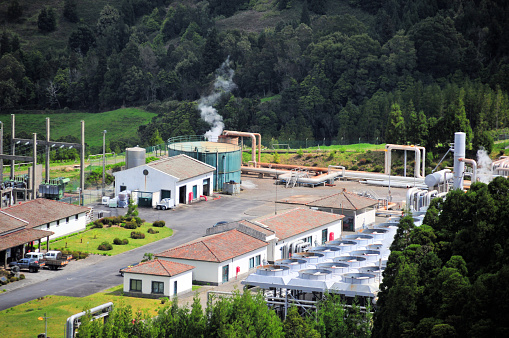
Calcite scaling in the Azores (such as in the Ribeira Grande geothermal field on São Miguel Island) has been primarily solved using downhole chemical scale inhibition. By continuously injecting antiscalant polymers via stainless steel capillary tubing, operators prevent the crystallization and buildup of calcium carbonate. (NALCO pHREEdom(R) 5200M, a formulation of liquid polymeric dispersants and a patented inhibitor, specially designed to prevent the deposition of calcium carbonate is used.)